Bucket Details
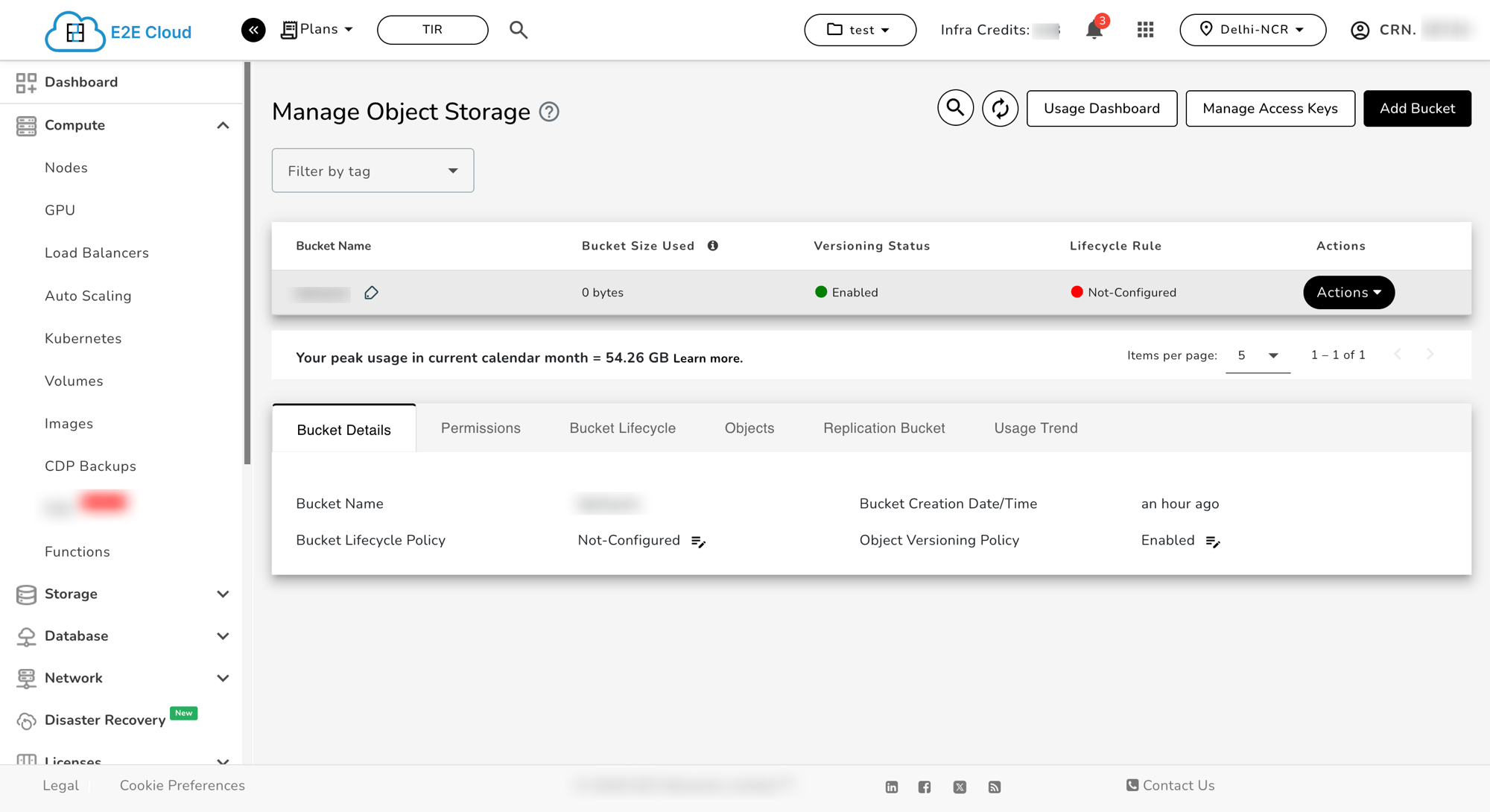
The bucket detail panel is accessible by clicking any bucket in the Manage Object Storage list. It contains the following tabs.
Objects
The Objects tab lists all objects stored in the bucket. From here you can:
- Upload — click Upload to select and upload files from your local system.
- Delete — select an object and click Delete under the Actions menu to permanently remove it.
- View all versions — if versioning is enabled, click View All Versions to see every version of every object with its version ID, size, and timestamp.
Version Actions
When viewing all versions of an object, the following actions are available under the three-dot menu for each version:
- Generate Presigned URL — creates a time-limited download link for that specific version.
- Download — directly downloads the version to your local machine.
- Delete version — removes only that version, leaving other versions intact.
Bucket Lifecycle
The Bucket Lifecycle tab lists all lifecycle rules configured for the bucket. Each rule defines when objects are automatically deleted.
From this tab you can:
- View all existing lifecycle rules with their names and expiry settings.
- Create a new rule by clicking Add Rule.
- Edit or delete existing rules via the Actions menu on each rule.
Bucket Details
The Bucket Details tab displays metadata for the bucket, including:
- Bucket name and region
- Creation date
- Versioning status
- Encryption status
- Object lock status
Permissions
The Permissions tab is where you create and manage access keys that control who can read from or write to this bucket via CLI or API.
To create an access key for this bucket:
-
Click Create Access Key.
-
Enter a name for the key (e.g., application name, team name).
-
Select an existing key or generate a new one.
-
Assign a role:
Role Permissions bucket admin read, write, manage bucket writer read, write bucket reader read only -
Click Save.
For full details on managing access keys, see Access Keys.
Replication Bucket
The Replication Bucket tab lists all replication rules configured for the bucket and lets you create new ones directly from here.
Configure a Replication Rule
To set up replication from this tab:
- Click Add Replication Rule.
- Enter the destination bucket details and region.
- Click Save.
For enabling replication rule, versioning must be enabled for the bucket.
Manage Existing Rules
For each configured rule, the tab shows the destination bucket name, region, and current replication status. Available actions per rule:
- Disable — pauses replication without deleting the rule.
- Delete — permanently removes the rule.
Usage Trend
The Usage Trend tab shows a time-series chart of storage consumption for the individual bucket, useful for tracking growth and identifying unexpected spikes.
Date Range
Use the period dropdown to select a time range:
| Option | Description |
|---|---|
| This Month | Storage usage from the start of the current calendar month |
| Last Month | Storage usage for the previous calendar month |
| Past 3 Months | Storage usage over the last three calendar months |
| Custom | Select an exact start and end date for targeted analysis |
Chart
The chart displays:
| Element | Description |
|---|---|
| Y-axis | Storage size in GB |
| X-axis | Dates within the selected range |
| Solid line | Actual storage usage over time |
| Red dotted line | Peak usage reference line for the period |
For a cross-bucket usage overview and month-over-month metrics, see the EOS Usage Dashboard.